
PlayStation Is Ending Physical Disc Production in 2028: What It Means for Gamers, Collectors, and the Future of PS5 and PS6
By Ibaad Ur Rehman
July 21, 2026
Sony’s shift to an all-digital future has sparked outrage, lawsuits, and a long-overdue conversation about who really owns their games.
Quick Summary (TL;DR)
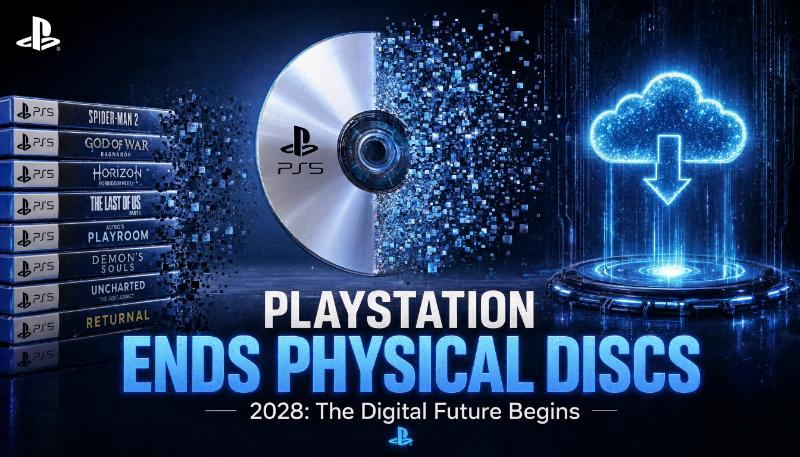
On July 1, 2026, Sony Interactive Entertainment confirmed on the official PlayStation Blog that it will stop producing physical discs for all new PlayStation games starting January 2028. After that date, every new PlayStation release will be sold only through the PlayStation Store or as digital codes at retail. Games that already exist on disc, or that launch before the cutoff, are not affected, your PS5 will still play every disc you own. But the announcement marks the beginning of the end for one of gaming’s oldest traditions, and it has triggered backlash across Reddit, consumer rights groups, and even a class-action-style lawsuit in the Netherlands.
This article breaks down exactly what Sony announced, why it’s happening now, how gamers and industry insiders are reacting, and what it means for the future of the PS5, the upcoming PS6, and physical game ownership as a whole.
What Sony Actually Announced
The announcement came directly from Sid Shuman, Senior Director of Content Communications at Sony Interactive Entertainment, in a PlayStation Blog post published on July 1, 2026. The key points are simple:
- Starting January 2028, physical disc production for all new PlayStation games will be discontinued.
- New games released after that date will be available only in digital format, through the PlayStation Store or digital codes sold at retailers.
- Games released before January 2028 are completely unaffected. If a game already shipped on disc, or is scheduled to release on disc before the cutoff, that physical version stays exactly as it is.
- Existing PS5 consoles with disc drives will continue to play every disc already in circulation. This is not a hardware change — it’s a manufacturing and distribution change.
Sony framed the move as a natural response to how people already buy games. In the company’s own words, the decision reflects a desire to “align more closely with how most of our community prefers to access and play games today.”
The announcement also arrived alongside a second, related move: Sony confirmed it is shutting down the PlayStation Store on PS3 in select regions later this year, with the PS3 and PS Vita stores closing globally in 2027. Once those storefronts go dark, players will no longer be able to buy new digital content for those older systems, although previously purchased games will remain downloadable for the time being.
Why Now? The Numbers Behind the Decision
Sony didn’t make this decision in a vacuum. Digital game sales have been quietly overtaking physical sales for years, and the gap has only widened:
- Industry analysts estimate that digital sales already account for roughly 80% of PlayStation software sales.
- Sony’s own FY2025 financial data reportedly shows digital units outselling physical copies by more than 3 to 1.
- Back in 2020, around 74% of total video game industry sales were already digital — and that number has climbed steadily every year since.
This mirrors what’s already happened in music and film. Streaming crushed DVD and CD sales over the last decade, and Netflix shut down its DVD-by-mail rental business back in 2023. Interestingly, physical media hasn’t disappeared everywhere — vinyl records have staged a genuine comeback, topping $1 billion in annual sales for the first time since 1983. But games are following the movies and TV playbook, not the vinyl one.
There’s also a timing detail that can’t be ignored: this announcement landed just days after Rockstar Games confirmed that Grand Theft Auto 6’s “physical edition” will not include an actual disc at all — just a download code inside a box. That decision alone caused a wave of frustration among collectors, and many see Sony’s announcement as the platform holder simply catching up to where its biggest publishers already are.
How Gamers Are Reacting
The backlash has been loud, immediate, and not limited to a few angry tweets.
Thousands of comments flooded the original PlayStation Blog post, ranging from disappointment to outright threats to abandon the platform. The core complaints that keep surfacing across Reddit threads, gaming forums, and comment sections include:
- Loss of the resale market. Without physical discs, there’s no more trading games in, buying used copies for a fraction of the price, or lending a game to a friend. One frequently cited Reddit comment pointed out that older “Greatest Hits” physical games that shipped at $20 still hold their value on resale sites like eBay ten or twenty years later — digital purchases can’t do that.
- No true ownership. A common phrase circulating in the community: “digital purchases are rentals.” If a storefront shuts down, delists a game, or a publisher pulls support, the games you paid for can effectively vanish. This fear isn’t hypothetical — it’s exactly what’s happening with the PS3 and Vita stores right now.
- Internet dependency. Reddit users have shared real examples of being locked out of their own single-player games during internet or server outages, since digital libraries and license verification often require a connection, even for offline play.
- Preservation concerns. Game historians and archivists worry that an all-digital catalog is far easier for a company to quietly delete than a warehouse full of physical discs, raising long-term questions about how future generations will access today’s games at all.
The anger hasn’t stayed online. According to reports circulating on Reddit, a Dutch consumer advocacy group called Stichting Massaschade & Consument has filed a lawsuit valued at roughly $457 million on behalf of an estimated 1.7 million Dutch PlayStation users. The core argument: once physical alternatives disappear, Sony’s 30% PlayStation Store commission will have nothing to compete against, effectively creating a digital monopoly that can drive game prices higher without any competitive pressure from retail or resale markets.
What This Means for PS5 Owners Right Now
If you own a PS5, here’s the part that matters most: nothing changes immediately.
- Every disc you currently own will keep working exactly as it does today.
- The PS5 Disc Edition and detachable disc drive accessory aren’t being discontinued by this announcement — Sony hasn’t said anything about pulling disc-compatible hardware from shelves.
- Games releasing between now and January 2028 can still ship on disc, at the publisher’s discretion.
- Retailers will still be allowed to sell existing physical stock even after Sony stops manufacturing new discs, so physical copies of pre-2028 games won’t vanish from shelves overnight.
The practical effect is a slow fade rather than a sudden cutoff. Publishers now have roughly 18 months of runway before physical becomes technically impossible for new titles, and expect many big releases between now and then to lean further into “digital-first” bundles, code-in-a-box editions, or limited disc print runs aimed at collectors.
What Happens to the PS5 Digital Edition?
This is one of the more interesting side effects. Right now, Sony sells two versions of its console:
- PlayStation 5 Digital Edition — currently priced at $599.99
- PlayStation 5 Slim Disc Edition (1TB) — currently priced at $649.99
Once disc-based games stop being manufactured, the entire premise of a “Disc Edition” console starts to lose its purpose. It’s reasonable to expect Sony to eventually phase out disc-drive hardware entirely for future revisions, or keep it around only as a niche add-on for playing legacy titles and Blu-ray movies.
Does This Affect the PS6?
This is where things get genuinely uncertain, and where Sony’s messaging has been mixed.
A hardware leaker known as KeplerL2, posting on the NeoGAF forums, claimed the still-unannounced PlayStation 6 will not have a built-in disc drive, and will reportedly ship with a base 1TB SSD — the same storage as most current PS5 models, a decision some attribute to an ongoing AI-driven global RAM shortage affecting component costs.
However, former PlayStation executive Shawn Layden pushed back on the idea that Sony will go fully digital worldwide. In an interview, Layden argued that while an all-digital approach has worked for Xbox in Western markets like the US, Canada, Australia, and New Zealand, physical media still matters enormously in other regions. Since PlayStation is the most popular gaming platform in over 170 countries, Layden believes it wouldn’t make business sense for Sony to alienate international markets that still rely heavily on physical discs.
Adding another layer to the PS6 speculation: PlayStation architect Mark Cerny has confirmed Sony is working with AMD on a project codenamed “Amethyst,” widely believed to be tied to the next-generation console, with some rumors pointing to a 2027 launch window — though that timeline should be treated cautiously.
How This Compares to Xbox and Nintendo
Sony isn’t the first to make a move like this, but it is the first of the “big three” to set a hard, public deadline for physical disc production of new games platform-wide.
- Xbox has already leaned heavily into digital-only hardware with the Xbox Series S, and is reportedly testing tools that let players convert owned physical discs into digital licenses. However, as of this announcement, Microsoft has not confirmed a full stop to Xbox Series X physical disc manufacturing.
- Nintendo has historically been the most resistant to going fully digital, largely because physical cartridges remain popular in markets outside North America and Europe.
This makes Sony’s move the most aggressive and specific commitment yet from a major console maker — a firm date, not just a “digital is the future” statement.
The Bigger Picture: Physical Media's Slow Fade
Sony’s decision fits into a much larger pattern that’s played out across nearly every entertainment medium over the last fifteen years:
- Music moved from CDs to streaming, with only vinyl surviving as a niche collector’s format.
- Movies and TV moved from DVD and Blu-ray to streaming platforms, with Netflix ending its physical rental business years ago.
- Now games are following the same arc, just later, because game discs also function as software installers, not just playback media — making the transition technically messier than swapping a DVD for a Netflix subscription.
What makes gaming different, and why the backlash has been sharper than in music or film, is the ownership question. A digital movie license and a digital game license both carry the same risk of disappearing if a service shuts down. But games are interactive software people spend hundreds of hours inside of, often replaying for years or even decades. Losing access to a purchased game because a storefront closes feels fundamentally different from losing access to a movie you might watch once.
Frequently Asked Questions
Will my existing PS5 discs stop working? No. Any disc you already own will continue to work on any PS5 with a disc drive. This announcement only affects the manufacturing of new discs for games releasing after January 2028.
Can I still buy physical PS5 games after 2028? You’ll still be able to buy existing physical stock through retailers even after Sony stops manufacturing new discs — but no new titles will be produced on disc going forward.
Is Sony discontinuing the PS5 Disc Edition console? Not officially. As of this announcement, the Disc Edition and detachable disc drive remain available, though their long-term future is uncertain given this shift.
Will the PS6 have a disc drive? It’s unconfirmed. Leaks suggest the base PS6 may skip a built-in disc drive entirely, though a former PlayStation executive has argued Sony is unlikely to go fully digital worldwide because of how important physical media remains in international markets.
Why is this happening now, right after the GTA 6 controversy? The timing isn’t a coincidence in the eyes of most analysts. Rockstar’s decision to ship Grand Theft Auto 6’s “physical edition” as a code-in-a-box rather than an actual disc signaled that even the biggest publishers in the industry were already moving away from discs — Sony’s announcement essentially formalizes that shift at the platform level.
Final Thoughts
Sony’s decision to end physical disc production by January 2028 doesn’t kill physical gaming overnight, but it does mark a clear and permanent turning point. For casual players who already buy everything digitally, almost nothing changes. For collectors, resellers, and anyone who values true ownership over a licensed subscription-style library, this is the moment the writing on the wall became official policy.
The next 18 months will likely see a rush of publishers releasing “last physical edition” style collector’s releases, a growing secondhand market for existing discs as their scarcity value rises, and continued pressure from consumer groups questioning whether an all-digital future actually benefits players — or just protects platform holders’ storefront commissions.
Whatever happens with the PS6, one thing is now certain: the era of walking into a store and picking up a brand-new PlayStation game off a shelf is entering its final chapter.